
Mykonos and the History of the Cyclades: An Island Shaped by Aegean Civilization
Mykonos is widely recognized around the world for its striking architecture, vibrant lifestyle, and cosmopolitan appeal, but beneath this modern image lies a deep historical connection to the Cyclades — a group of islands in the heart of the Aegean Sea. The story of Mykonos is intertwined with the wider history of this region, one of the earliest centers of maritime culture, ancient trade, and early Greek civilization. Exploring the history of Mykonos and its neighbors reveals how geography, culture, and human movement helped shape this island’s rich identity.
The Cyclades were among the earliest inhabited islands in the Aegean, with evidence of settlement dating back to the Neolithic era. These islands developed strong maritime traditions early on, enabling trade, cultural exchange, and communication across the sea that linked mainland Greece, Asia Minor, and Crete. During the Early Bronze Age, the Cycladic civilization emerged, known for its marble figurines, craftsmanship, and organized networks of marine travel that are considered foundational to the development of later Greek cultures.
The Cyclades as a Cultural and Commercial Hub
The central location of the Cyclades made them natural meeting points for seafarers, traders, and early settlers. Mykonos, while not as large as some neighboring islands, benefited from its position within this network. Its proximity to other important islands allowed it to participate in economic and cultural exchange. This early maritime connectivity helped foster a dynamic environment where ideas, goods, and people flowed across the region.
The Cycladic civilization developed distinctive artistic traditions, including sculptural figurines and pottery that have been discovered in archaeological sites across the islands. These artifacts suggest complex social structures and spiritual practices that predated classical Greek culture. The sophistication of these early communities provides important insight into how island societies adapted to and thrived in the Aegean environment.
Mykonos in Antiquity and the Sacred Island of Delos
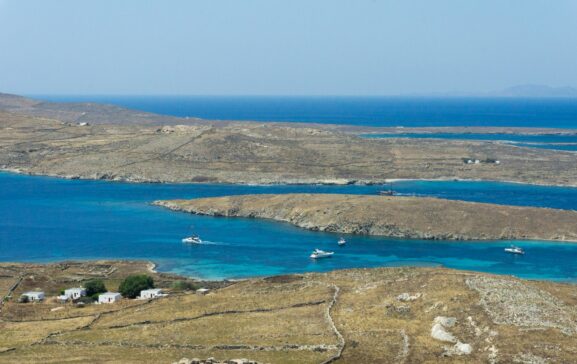
Mykonos’ historical importance is closely tied to its proximity to the nearby island of Delos. In ancient Greek tradition, Delos was considered the birthplace of the twin gods Apollo and Artemis, making it one of the most sacred sites in the Aegean. For centuries, Delos served as a major religious, cultural, and commercial center. Pilgrims, traders, and settlers visited its temples, markets, and public spaces, contributing to its status as a hub of Mediterranean civilization.
Mykonos functioned as a supporting island to Delos, providing resources, labor, and safe passage for those traveling through this part of the Aegean. Although Mykonos itself did not achieve the same level of wealth or renown as Delos in antiquity, its strategic role within the Cycladic network gave it lasting significance. The physical and spiritual proximity to Delos shaped Mykonos’ identity and helped integrate it into the broader historical narrative of the region.
Roman, Byzantine, and Medieval Influences
As the Cyclades came under Roman rule, Mykonos and its neighboring islands became part of a larger imperial system. The influence of Roman governance and infrastructure brought changes to settlement patterns, trade routes, and local administration. Christianity spread through the island during the Byzantine period, and structures such as churches and religious communities became focal points for social and spiritual life.
During the medieval era, Venetian influence extended across the Cyclades, leaving an imprint on architecture, defense structures, and governance. Mykonos, like many islands in the Aegean, adapted these influences while maintaining a distinct local identity. The island’s position along maritime routes continued to make it a place of interaction between different cultural and political systems.
Ottoman Rule and Maritime Tradition
Under Ottoman control, the Cyclades experienced varying degrees of autonomy and influence. Mykonos developed a strong seafaring tradition during this period, as maritime trade, fishing, and shipbuilding remained central to island life. These activities shaped not only the local economy but also the cultural practices that emphasized resilience, independence, and adaptability.
The island’s reliance on the sea influenced its social structures and artistic expression, reinforcing connections to marine life and navigation. Mykonos’ maritime legacy continued to play a role in its development long after the decline of Ottoman authority.
Architecture, Landscape, and Cultural Continuity
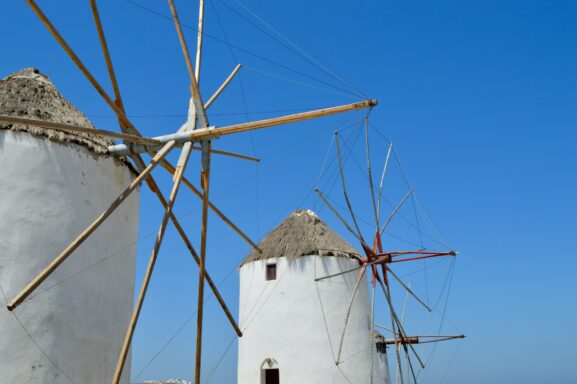
The iconic Cycladic architecture seen throughout Mykonos — with its whitewashed houses, narrow streets, and minimal geometric forms — developed as a practical response to climate, topography, and social needs. This architectural style, shared across many islands, reflects centuries of adaptation to intense sunlight, wind, and seafaring cultures.
Despite modern development, Mykonos retains elements of its Cycladic heritage through traditional celebrations, religious festivals, and everyday practices that honor its past. These cultural continuities provide a living connection to the island’s early history, allowing visitors to grasp both the ancient roots and evolving identity of Mykonos.
Mykonos and the Cyclades Today
Today, Mykonos stands as one of the most famous islands in the Cyclades, attracting visitors from across the globe. While tourism has transformed the island in many ways, its historical foundations continue to shape the character of the place. The balance between tradition and modernity, between sea and settlement, reveals a continuity that stretches back millennia.
Understanding the history of Mykonos within the larger context of the Cyclades enriches the visitor experience. It reveals an island whose identity is not only defined by contemporary attractions but also by a deep heritage rooted in ancient civilization, maritime exchange, and cultural adaptation.